

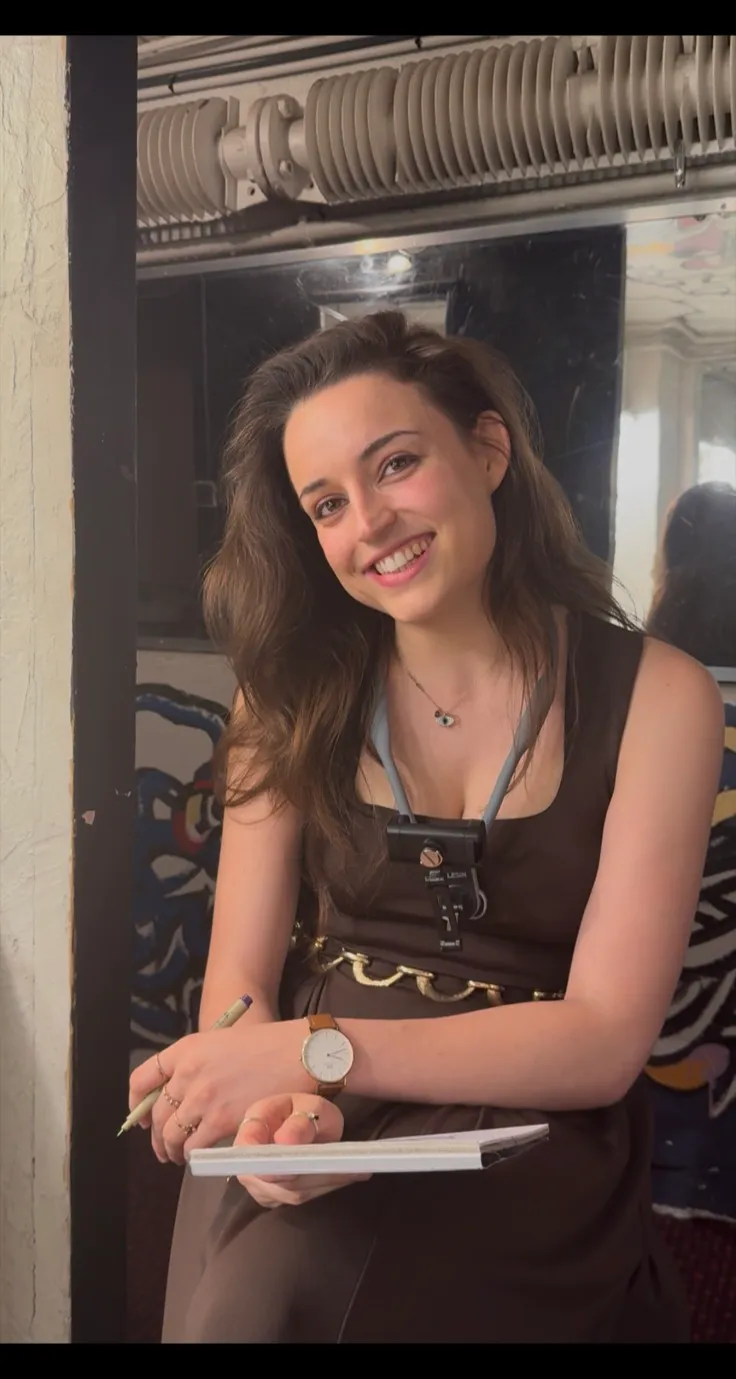
Anne Leblanc is an illustrator based in Paris. Before she learned to draw, she first learned to look.
She started out at a theater school, which she attended for about 2 years — a first way of observing people: bodies, expressions, the way a presence can say something without speaking.
« That time remains essential to my path — my work today is still deeply tied to observing others. »
She then moved on to studying architecture and set design — a shift driven by a desire to work with space, images and staging, and by a question at the heart of set design: how do you tell a story visually?
Her path then continued at the Théâtre de l'Européen: she has run it since the age of 23, balancing technical work and artistic direction. It's in this setting that she draws performers live on stage, including comedian Léopold Lemarchand, in front of about 350 people.
Drawing gradually became her main means of expression. In September 2024, she started posting her drawings on Instagram — first her friends, then strangers she met in the parks and streets of Paris.
« What interests me is meeting someone, observing them for several minutes, and trying to understand what makes up their face, their attitude, their presence. I'm not trying to reproduce someone: for me, drawing is a way of truly looking at a person. »
She loves drawing on the spot, wherever she is — at the beach, in a restaurant, in the street, in the middle of an event — as soon as she can pull out a notebook and a pen, with that immediate, unpredictable quality: observing someone, making choices very fast, and conveying something of them with very little. Filming her drawings and sharing them online became an important step in her path — both an artistic practice and a way of meeting people.

Observe, understand, simplify, share
Anne is naturally very observant: she likes watching people, listening to their conversations, noticing small details, understanding the dynamics between them — and can spend a lot of time trying to understand something before producing a response.
In her work, she tries to turn that observation into something creative: understanding, then simplifying it into an image — starting from something complex, a person, an emotion, an idea, and drawing out its essence. That's also what draws her to comics and to making things easy to understand: turning a complicated idea into something accessible through simple images.
Paper as material
Paper plays an important role in her practice. Anne has no interest in digitally reproducing the look of traditional drawing: she likes working with the material itself — paper, marker, pencil — and the happy accidents that can happen while drawing.
« I wondered a lot whether I should switch to drawing on a tablet, like a lot of other illustrators do. But I realized I deeply love paper — today I want to make it a real strength, rather than something less modern. »
She works on Bristol paper with alcohol markers and colored pencils for her portraits, and a lot with a ballpoint pen in a notebook. She likes the object to physically exist before it's digitized — scanning is simply a way of carrying a physical object into the digital world.
The encounter above all
The encounter is at the heart of her practice. When Anne draws someone, it's never just about making their portrait — it's about talking with that person, discovering who they are, what they think, what they dream about. The drawing becomes an excuse for the encounter — and a small event in itself: you sit down, let yourself be observed for a few minutes, see your portrait, and walk away with something unexpected.
Anne is also drawn to systems and formats: taking in a lot of information, looking for the connections between it, then “wringing it out” until a central idea emerges. Today she wants to develop a practice that sits between drawing, observation, encounter, and sharing.
What she looks for in drawing
Anne isn't after the most virtuosic or detailed drawing possible, but the right way to convey an idea to someone. Liv Strömquist's work reinforced that belief for her: the way she takes complex subjects — sociology, love, human relationships — and turns them into accessible comics shows that simplicity can be a strength.
She's also drawn to artists who turn something personal into something universal — an experience, a specific detail, that many people can recognize themselves in. It's a direction she'd like to keep developing in her own work.